
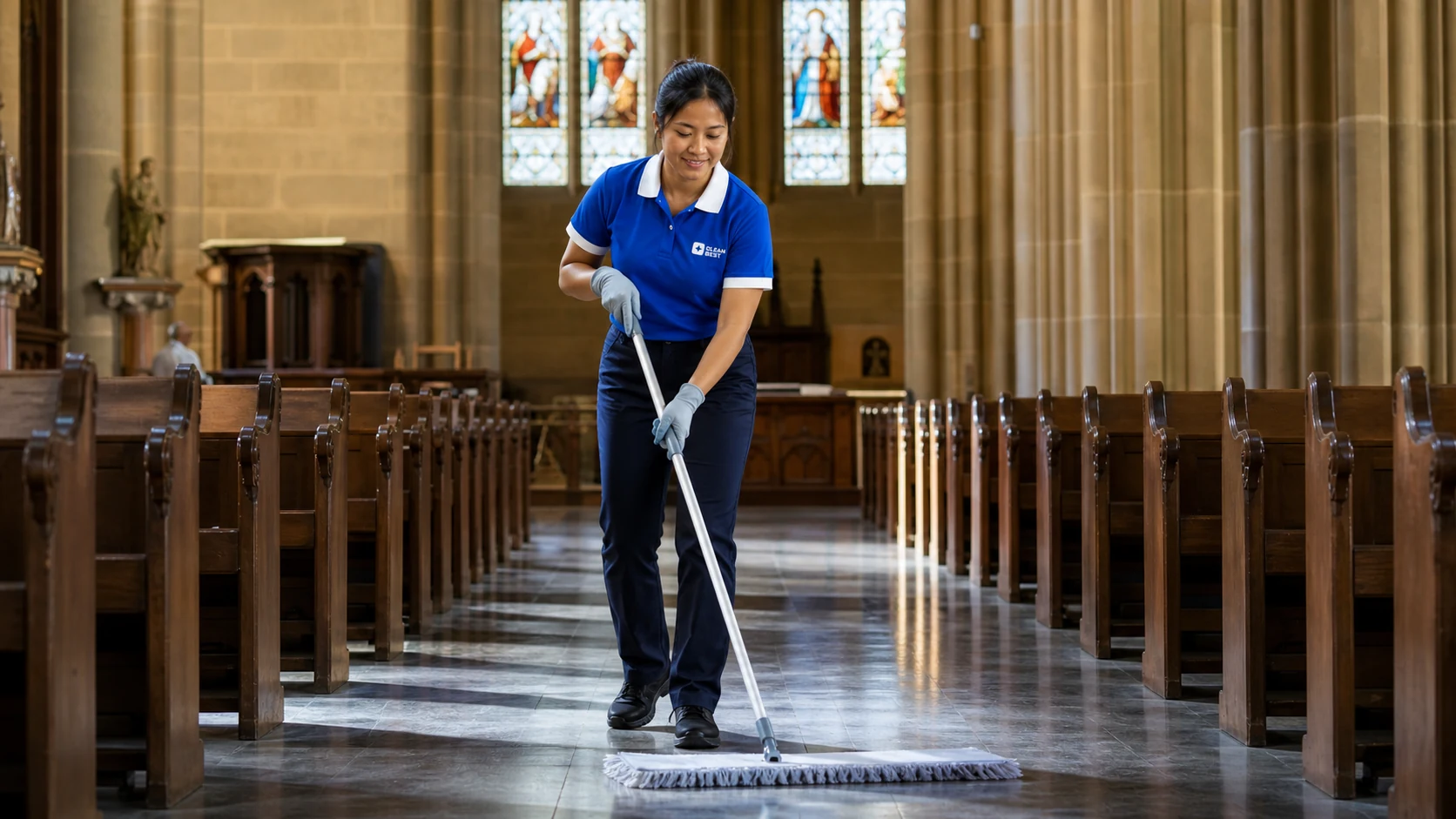
Places of worship · Western Sydney
Church Cleaning Parramatta and Western Sydney
Heritage timber, brass, stone and tile treated the way they should be — gently, with pH-neutral chemistry and a slow cycle. Halls and kitchens across Parramatta and Blacktown cleaned to a food-service standard. And never, under any circumstances, a cleaner working during a service.
- We do not clean during a service or a funeral. Ever.
- pH-neutral chemistry on original tile, stone and oiled timber
- Parish hall and kitchen scoped as the bigger job, because it is
- Rostered from your actual calendar, bookings included
10+ years cleaning Sydney
Police-checked cleaners, insured, and rostered around Sydney traffic rather than a formula
Rostered this week in
- Parramatta
- Blacktown
- Seven Hills
- Merrylands
- $20m public liabilityPolice-checked cleaners, inducted on your building
- Rolling agreementWritten price inside 24 hours, no lock-in
What does church cleaning involve in Parramatta?
Church cleaning is the scheduled cleaning of a place of worship and its associated buildings, timed around the service and booking calendar rather than around business hours.
The worship space typically requires gentle treatment of heritage materials: oiled or waxed timber pews and panelling, brass fittings, stone or original tessellated tile floors, and carpet runners in the aisles. These surfaces are damaged by strong alkaline products and are cleaned with pH-neutral chemistry and soft pads.
In most Parramatta and Blacktown parishes the hall, kitchen and amenities generate more cleaning work than the worship space itself, because they are used for playgroups, community classes, meetings and hired events throughout the week. Kitchens are cleaned to a food-service standard. Clean Best does not clean during a service or a funeral and reschedules rounds when short-notice services are held.
- 10+ years cleaning SydneyOn the road since 2015
- Police-checked cleanersBuilding-inducted, WWCC-cleared where the site needs it
- $20m public liabilityCertificate of currency on request
- Written quote in 24 hoursFixed price, no lock-in contract
The detail
Church cleaning Parramatta parishes can trust with the building
Church cleaning Parramatta parishes need is really two jobs wearing one name. There is the worship space, which is old, materially delicate, and used at very specific and sometimes unpredictable times. And there is the hall, which is a hard-working community venue getting hammered six nights a week by playgroups, meetings, community language classes and the occasional hired birthday party. They demand opposite things, and a contractor who treats them as one job will do both badly.
The surfaces, and how contractors destroy them
Old church timber is almost never polyurethaned. Pews, panelling, altar rails and choir stalls are usually oiled or waxed, and a modern general-purpose spray will strip that finish and leave the timber looking dry and grey. It is slow to notice and it takes a long time to bring back. Timber gets a damp cloth and, on a slow cycle, an appropriate oil treatment.
Brass is polished with a product suited to brass rather than scoured, because the patina on old fittings does not come back once it has been taken off. Heritage tile — tessellated, encaustic — and sandstone flagging can be permanently etched by an alkaline stripper, which is the default bottle in most cleaners’ vans. Original surfaces get pH-neutral chemistry and a soft pad, and if a floor genuinely needs restoration rather than cleaning we will tell you to get a conservator instead of quietly experimenting on it.
The calendar, which is not negotiable
We do not clean during a service. We do not clean during a funeral. If one is running, the cleaner works elsewhere in the building or comes back. That sounds like an obvious courtesy and it is genuinely not the industry norm — plenty of congregations have had a contractor vacuuming the narthex during a eulogy, and it is not something anybody forgets.
Funerals are frequently called at short notice. Tell us and we move the round. It is not a variation and it does not cost anything; it is simply how the work should be done in a building that exists for this purpose.
The hall is the bigger job
In most Sydney parishes the hall carries far more cleaning load than the church. Playgroup on Monday morning with a floor covered in whatever a two-year-old brings. Community language school on Saturday. A twelve-step meeting on Tuesday night with forty cups of tea. Scouts. A hired party. The kitchen is not a kitchenette, it is a working food-service kitchen and it needs to be cleaned like one: benches, sinks, splashbacks, appliance exteriors, the floor including under the equipment, and bins washed rather than relined.
Amenities in a busy hall take a beating too, and they are the space that decides what a visiting family thinks of the parish. They get daily-standard attention on every round, not a wipe on the way out.
Carpet runners and the aisle
The aisle carpet and the runners take concentrated foot traffic in a very narrow strip, which is exactly the condition that produces a grey lane. They get vacuumed thoroughly each round and hot-water extracted periodically — and scheduled well away from any wedding, because a damp aisle at a wedding is not a mistake anybody survives twice.
Mosques, temples and synagogues
The same principles apply with different specifics, and we ask rather than assume. Prayer halls where people are barefoot need particular attention and often a footwear protocol for the cleaner. Ablution facilities need a hygiene standard closer to a medical amenity than an office washroom. Carpeted prayer spaces need frequent, thorough vacuuming and careful periodic extraction. Tell us the customs and requirements of the space at the walkthrough and we will work to them.
Who we send
Police-checked cleaners, the same people each round, who understand that they are working in a building that matters to the people who use it. Ring 02 5839 3012 and we will walk the building with whoever holds the calendar.
Heritage surfaces
The strongest bottle in the van has ruined more old timber than time has
Oiled pews stripped by a general-purpose spray. Original tessellated tile etched by an alkaline cleaner. Brass scoured back past its patina. Every one of those is permanent, every one was done by somebody trying to be thorough, and every one could have been avoided by asking what the surface was first.
So that is what we do. At the walkthrough we identify what each material actually is, and the chemistry follows from that — pH-neutral on original tile and stone, damp cloth and a slow oil cycle on timber, a brass-appropriate polish on fittings. And where a surface needs a conservator rather than a cleaner, we say so.
- Materials identified at the walkthrough, before anything is applied
- pH-neutral chemistry on original tile, stone and terrazzo
- Oiled and waxed timber treated on a slow cycle, never stripped
- We recommend a conservator when restoration, not cleaning, is needed
The scope
What we clean across the parish
Worship space and hall scoped separately, because they need genuinely different work.
- Dust and damp-wipe pews, panelling, altar rails and choir stalls with a timber-safe method
- Polish brass fittings with a brass-appropriate product — never scoured
- Clean heritage tile, stone and terrazzo floors with pH-neutral chemistry and a soft pad
- Vacuum aisle carpet and runners thoroughly; extract periodically, well away from weddings
- Clean the narthex, entry doors, entry glass and noticeboards
- Dust ledges, sills, statuary plinths and fixtures within safe reach
- Clean the sacristy and vestry to the standard the clergy ask for
- Clean the parish hall floor, tables, chairs and stacked seating
- Clean the hall kitchen to a food-service standard — benches, sinks, appliance exteriors, floor
- Wash hall and kitchen bins rather than merely relining them
- Clean all amenities daily-standard; restock paper, soap and hand towel
- Sweep and wash external entry steps, paths and the courtyard
- Remove cobwebs from entries, porches, ceiling corners and light fittings
- Report anything a cleaner cannot fix — a failing light, a lifting tile, a damp patch
Restoration of damaged heritage surfaces, high-level work in a nave, and stained-glass conservation are specialist trades. We will tell you when you need one rather than attempting it.
Pricing
Church quotes built from the calendar, the hall and the surfaces
The hall and the amenities usually drive the number more than the worship space does, and heritage surfaces take slower, gentler work. We scope both separately so you can see each.
Small parish
A single worship space with a modest hall, amenities and a kitchenette — one or two services a week.
- Weekly round timed between services
- Timber, brass and heritage surfaces treated gently
- Hall, kitchenette and amenities in the same visit
- Never cleaning during a service or a funeral
Fixed in writing before anybody picks up a mop.
Busy church and hall
A church with a heavily booked hall, several weekly services, a playgroup and community groups most evenings.
- Two or three rounds a week, built from your actual calendar
- Hall and kitchen cleaned to a food-service standard
- Carpet runners and aisle carpet extracted periodically
- Named supervisor and a documented monthly audit
Fixed in writing before anybody picks up a mop.
Large or heritage building
Cathedrals, large congregations, or buildings with significant heritage timber, stone or tile.
- pH-neutral chemistry and soft pads on all original surfaces
- Slow-cycle timber treatment and brass polishing programs
- Periodic deep cleans scheduled around the liturgical calendar
- Honest advice when a surface needs a conservator, not a cleaner
Fixed in writing before anybody picks up a mop.
We walk your site for nothing, then send the number within 24 hours.
Getting started
How we take on a Western Sydney parish
Four steps, and the calendar comes before anything else.
- 1
Walk it with the calendar
Services, playgroup, choir, community bookings, weddings, funerals. The calendar is the constraint, and it is not negotiable.
- 2
Identify the surfaces
Which timber is oiled, which tile is original, where the brass is. Getting this wrong once causes permanent damage.
- 3
Fixed price in writing
Within 24 hours, with the hall and the worship space scoped separately because they need very different work.
- 4
The quiet round begins
Between services, never during one. Short-notice funerals mean we reschedule, not that we work around them.
FAQ
Church cleaning questions from Western Sydney parishes
Timber, brass, heritage tile, funerals, halls, and places of worship of every kind.
When can you clean a Parramatta church that is used most days?
Between services and around the rest of the week's activity, which in a busy Sydney parish is considerable — playgroup on Monday, choir on Wednesday, a funeral at short notice, a wedding on Saturday, a community group in the hall most evenings. We build the roster from your actual calendar rather than assuming the building is empty from Monday to Friday, and we ask to be told about short-notice services rather than turning up in the middle of one.
Do you know how to clean old timber and brass?
Yes, and the short version is: gently, and with far less product than people assume. Old church timber — pews, panelling, altar rails — is usually oiled or waxed rather than polyurethaned, and a modern general-purpose spray will strip the finish and leave it looking dry and grey. It gets a damp cloth and, where appropriate, an oil-based treatment on a slow cycle. Brass is polished with a product suited to it, not scoured, because the patina on old brass does not come back.
What about heritage tile and stone floors?
Very carefully. A lot of Sydney's older churches have tessellated tile, sandstone flagging or encaustic tile, and every one of those can be permanently damaged by an alkaline stripper — which is the default bottle in most cleaners' vans. We use pH-neutral chemistry on original surfaces and a soft pad. If a floor genuinely needs restoration rather than cleaning, we will say so and recommend a conservator instead of experimenting on it.
Can you clean respectfully during a service or a funeral?
We simply do not clean during either. If a service or a funeral is running, our cleaner works elsewhere in the building or comes back. That is not a difficult policy to hold and it matters enormously to congregations who have had contractors vacuuming in the narthex during a eulogy. Tell us about short-notice funerals and we will reschedule the round rather than proceed and hope nobody minds.
Do you clean the hall and the community spaces too?
Usually those are the bulk of the work. Parish halls in Sydney are booked constantly — playgroups, community language classes, twelve-step meetings, scouts, a hired birthday party on Saturday — and they take far more punishment than the worship space does. Halls, kitchens, amenities and the floors get the same schedule, with the kitchen cleaned to a food-service standard because it is genuinely being used as one.
Do you work with mosques, temples and synagogues as well?
Yes, and the same principles apply with different specifics. Prayer halls and carpeted spaces where people are barefoot need particular care and often a different footwear protocol for the cleaner. Ablution facilities need a hygiene standard closer to a medical amenity than an office washroom. Tell us the requirements and the customs of the space at the walkthrough and we work to them rather than assuming.
How is church cleaning Parramatta work priced?
By the size of the worship space, how many services and events run in a week, whether there is a hall and a kitchen, and how much of the building has heritage surfaces that need slower, gentler work. Halls and amenities often drive it more than the worship space does. We walk the building with whoever knows the calendar and confirm a fixed figure in writing within 24 hours.
Keep going
What Western Sydney parishes book alongside the round
Same cleaners, same supervisor, one invoice to the parish.
Book church cleaning Parramatta congregations never have to think about
Heritage surfaces treated properly, halls cleaned to a food-service standard, and never a cleaner during a service. Call 02 5839 3012.